

How To Tell Chinese From Japanese Writing
To the untrained eye or ear, Asian languages can appear completely incomprehensible and indistinguishable from each other. The written characters may as well be hieroglyphs and unlike some other languages, listening in on a conversation isn't going to give you much to go on. The guide below it intended to provide a simple quick start for telling apart Chinese, Japanese and Korean. You'll soon find it's really rather simple!
Chinese
Chinese is the grandaddy of all East Asian languages and around one-fifth of the world's population speaks it in one form or another, the most widely spoken being Mandarin. The idea that all Chinese characters are pictorial is an erroneous one: most characters consist of asemantic element that indicates meaning, and aphonetic element that indicates the pronunciation. However, you'd have to learn a staggering 3,000 just to read a newspaper (out of around 40,000 in a Chinese dictionary).
Mandarin employs four distinct tones for pronunciation which can be described as high level, rising, falling then rising, and falling – e.g. mā (媽 – mother), má (麻 – hemp), mǎ (馬 – horse) and mà (罵 – scold) – it's very important to get them right otherwise you may end up calling your mum a horse (or worse)!
'Pleased to meet you' in Mandarin
我很高兴跟你见面 – Wǒ hěn gāoxìng gěn nǐ jiànmiàn (Pinyin)
我很高兴跟你见面 (Simplified Chinese – used in mainland China)
我很高興跟你見面 (Traditional Chinese – used in Hong Kong, Macau & Taiwan)
Looks: boxy, complex, many strokes (but simplified has less)
Sounds: loud, strong, aggressive, punctual
Common surnames: Li, Wang, Yang, Wu, Chen
Japanese
Just to make things confusing Japanese is written with a combination of three scripts: kanji (漢字) derived originally from Classical Chinese for regular usage, hiragana (ひらがな) for native Japanese words and katakana (カタカナ) for foreign words. Japanese has a relatively small sound inventory but is distinguished by a large number of local dialects and a complex system of honorifics which are used to indicate the relative status of the speaker, the listener, and persons mentioned in conversation. Japanese have some difficulty pronouncing the letter "r" since there is no direct corresponding sound.
'Pleased to meet you' in Japanese
初めまして – Hajimemashite (Rōmaji)
Looks: squiggly, cute, mixed
Sounds: soft, feminine, reserved, rolling
Common surnames: Sato, Yoshida, Sasaki, Suzuki
Korean
Despite also being derived from Chinese, Korean is somewhat easier to read than Chinese or Japanese since it has an alphabet (called Hangul) containing 24 consonants and vowels. However, instead of being written sequentially like the letters of the Latin alphabet, Hangul letters are grouped into blocks, such as 한han; each of these blocks transcribes a syllable, composed of three distinct letters: ㅎh, ㅏa, and ㄴn. Created in the mid-15th century, it is considered one of the most logically designed languages in the world.
'Pleased to meet you' in Korean
만나서 반갑습니다 – Mannaseo bangapseumnida (Romanised)
Looks: angular, ovals & straight lines, alphabetic
Sounds: smooth, melodious, repetitive, zig-zag
Common surnames: Kim, Park, Lee, Young
How to Type Asian Characters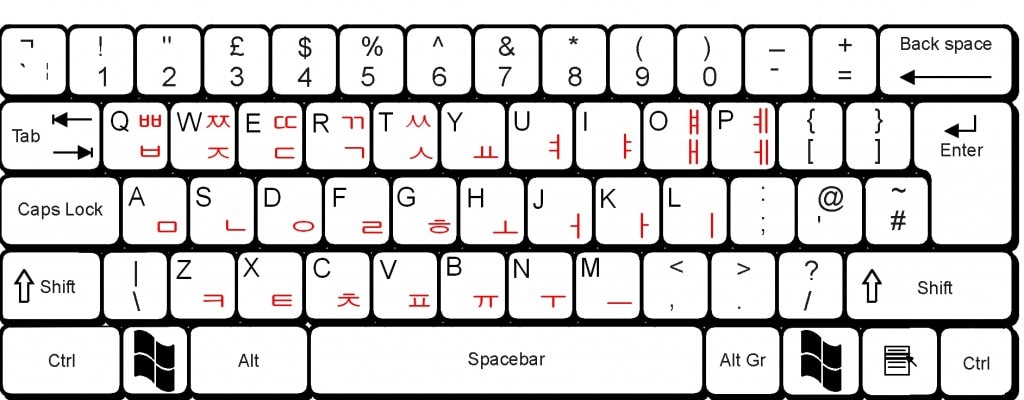
Many people have asked me in the past what a Chinese / Japanese / Korean keyboard looks like and the surprising answer is that they actually look almost exactly the same as yours with a standard QWERTY key layout (although some may have extra markings and a shortcut key to switch languages). A piece of software called an 'input method editor' (IME) automatically converts the romanised spelling into the corresponding characters on-screen as you type. It's arguably a bit slower to type this way but certainly more efficient than having a massive keyboard!
How To Tell Chinese From Japanese Writing
Source: https://randomwire.com/how-to-tell-the-difference-between-asian-languages/
Posted by: huckstepeareeter.blogspot.com
0 Response to "How To Tell Chinese From Japanese Writing"
Post a Comment